The Lifecycle
Nuclear Energy Lifecycle
The Lifecycle, explained
Stages
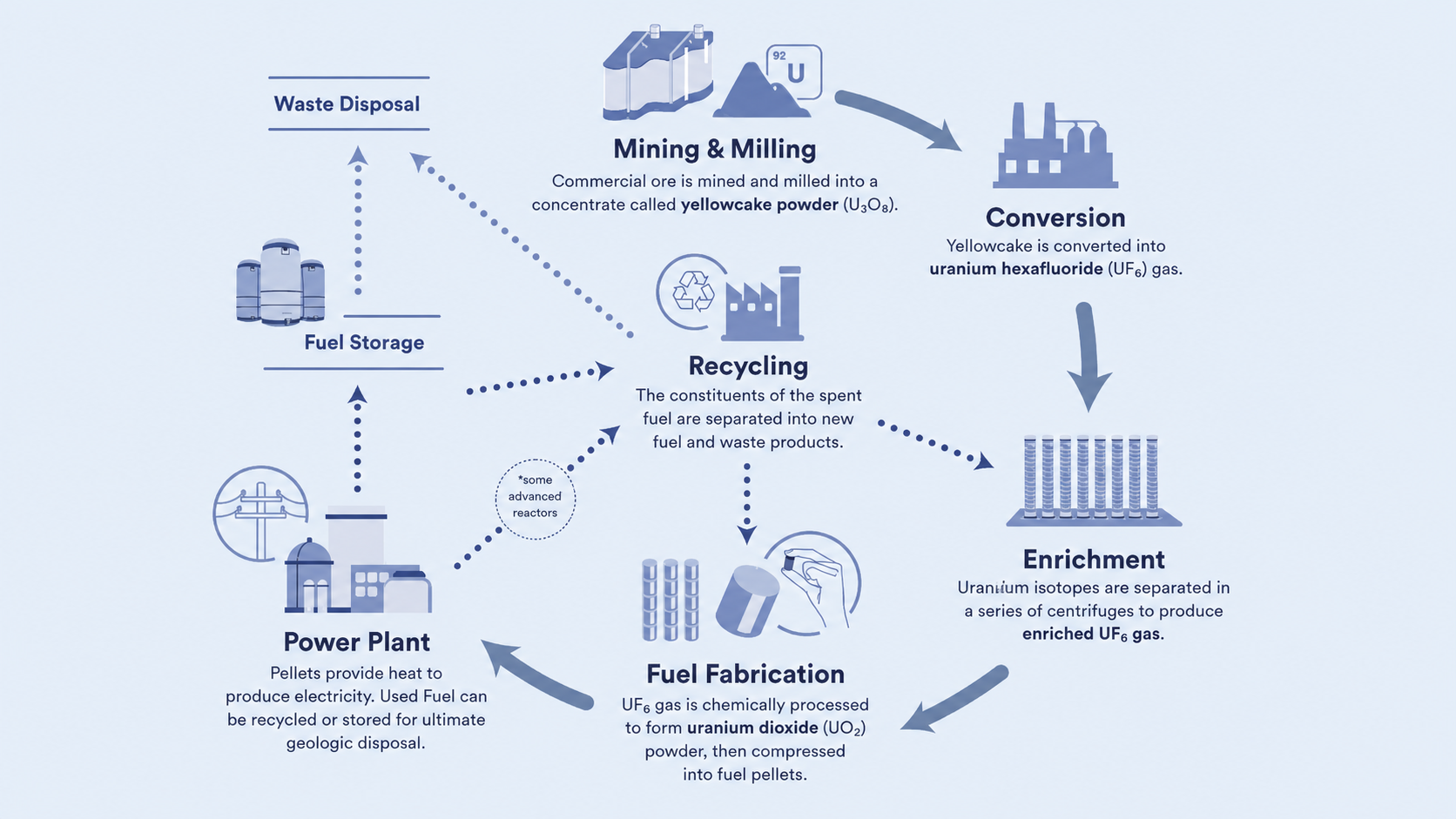
Mining & Milling
Front end
Uranium ore is extracted and processed into "yellowcake" — a concentrated uranium powder.
Conversion
Front end
Yellowcake is chemically transformed into uranium hexafluoride (UF₆), a gas that can be enriched.
Enrichment
Back end
Fuel Fabrication
Front end
Reactor Operations
Middle
Fuel is used to generate electricity or heat for industrial purposes. The Innovation Campus may host small modular reactors (SMRs) or microreactors rather than large traditional reactors.
Storage & Reprocessing
Back end
Used fuel is temporarily stored in pools, then transferred to dry casks. Reprocessing recovers usable uranium and plutonium from used fuel to provide new fuel for generating power.
Waste Management & Disposal
Back end
Low-level waste goes to licensed disposal sites. High-level waste requires long-term deep-geologic solutions still being developed nationally. The Innovation Campus would allow us to store and reprocess used nuclear fuel responsibly.